
May is Mental Health Awareness Month.
Written as a personal reflection in seven parts, this story explores grief, stigma, warning signs, community, and the powerful role human connection can play in helping someone stay.
Some sections may feel heavy. Please read at your own pace, take breaks when needed, and revisit the resources shared throughout the piece if you or someone you love may need support.
Part One: My Dad
My dad had the kind of presence that made a room feel warmer. In our small town, everybody knew him — not just because our family owned the local grocery stores, but because of who he was inside those walls and beyond them. He was the man who would quietly unlock the back door after hours and let a young mother walk out with formula and groceries she couldn't afford, never mentioning it again. He never needed the credit. Giving was just who he was.
He was brilliant in the way that defied explanation. Numbers bent to his will effortlessly. His humor was constant and genuine — the kind that caught you off guard and made you laugh before you even realized what had happened. And then there was the piano. He never had a lesson in his life, yet he composed his own songs for decades, pieces that were entirely his own. He could hear a song once and sit down and play it back nearly perfectly. It was a gift that felt almost impossible to witness, and yet there he was, doing it like it was the most natural thing in the world.
He was my dad. And for a long time, he was also quietly drowning.
Depression has a way of doing that — pulling someone under slowly, in a way that the people who love them most can miss, or misread, or desperately want to believe isn't as bad as it looks. For a long time, the signs were there. The withdrawal. The heaviness. The version of him that felt just out of reach no matter how close you stood.
And then one day, something changed.
He seemed lighter. More at peace. Almost like the weight had finally lifted, like he had found some kind of resolution we didn't know he'd been searching for. If you had asked me then, I might have exhaled for the first time in a long time. I might have thought — he's turning a corner.
He wasn't turning a corner. He had made a decision.
What I know now, and what I desperately wish I had known then, is that this shift — that unsettling calm after a long storm — can be one of the most dangerous moments in a person's struggle. When someone who has been suffering deeply suddenly seems at peace, it doesn't always mean they found hope. Sometimes it means they found a way out. The tunnel of depression had become unbearable, and in his mind, he had finally spotted the light at the end of it. That light was not what we prayed it would be.
My dad died by suicide. He was gone before any of us could reach him. The details of how he died were stark and devastating. In our small town, his death was followed by something I wasn't prepared for: silence. Whispers. The kind of quiet that settles over a community when no one knows what to say, so most people say nothing at all.
I don't carry anger toward the people who went quiet. I've come to understand that they weren't cruel — they were lost. No one had ever handed them a script for this. No one had taught them that showing up imperfectly is infinitely better than not showing up at all. The silence wasn't malice. It was the stigma of mental health, doing exactly what stigma does — keeping people frozen, keeping grief isolated, keeping the conversation buried.
That silence is what I'm here to break.
Part Two: Breaking the Silence
Mental health has an image problem.
For generations, struggling emotionally has been treated as something to push through privately, to hide from neighbors, to never speak of at the dinner table. We've handed down silence like an heirloom — not out of cruelty, but out of discomfort, out of not knowing better, out of a culture that confused vulnerability with weakness.
But here's what that silence costs us. It costs us the conversations that could have happened. The check-ins that might have mattered. The moments where someone who was drowning could have heard another human being say — I see you. I'm here. You don't have to carry this alone.
It may have cost me my dad.
I'm not saying that one conversation would have guaranteed a different outcome. Mental illness is complicated, and grief has a way of planting questions that never fully resolve. But I know this — he suffered largely in silence, in a world that didn't make it easy to do anything else. And the community that surrounded our family after his death responded the same way he had been conditioned to: with quiet.
We have to do better. And I believe we can.
Mental health conditions are not rare. Not even close. The National Alliance on Mental Illness estimates that 1 in 5 American adults experiences a mental health condition every single year. That means in any given room — any gym floor, any grocery store, any church pew, any family dinner table — someone is likely carrying something heavy that no one around them knows about. Someone is performing "fine" while running on empty. Someone is smiling while silently wondering if anyone would notice if they disappeared.
The stigma surrounding mental health doesn't just make people feel ashamed. It makes them less likely to seek help, less likely to open up, and in the most heartbreaking cases, more likely to suffer alone until they can't anymore.
Ending that stigma doesn't require a degree or a perfect set of words. It requires willingness. Willingness to ask. Willingness to listen without fixing. Willingness to sit in the discomfort of someone else's pain without running from it.
This blog is an invitation to be willing.
Whether you are someone who is struggling right now, someone who loves a person who is, or someone who simply wants to show up better for the people in your life, you are in the right place. There is no judgment here. There is no wrong way to feel. There is only the shared human experience of needing each other, and the profound, life-changing power of deciding to act on that.
My dad deserved that. So does yours. So do you.
Part Three: What the Signs Actually Look Like
We've all heard the warnings. Look for someone who seems sad, withdrawn, or who talks about not wanting to be here anymore. And those signs matter — they are real, and they are important. But if we only know how to recognize the obvious, we will miss the people who need us most.
My dad didn't die on a day when he seemed like he was in crisis. He died on a day when he seemed okay.
That is the part that stays with me. That is the part I need you to understand.
There is a phenomenon that is not talked about nearly enough in conversations about suicide prevention. It happens when someone who has been visibly suffering for a long time — withdrawn, heavy, unreachable — suddenly seems lighter. Calmer. Almost at peace. To the people who love them, it can feel like an exhale. Like the corner has finally been turned. Like whatever they were praying for has arrived.
What it can actually mean is that a decision has been made.
When the weight of suicidal ideation shifts from a painful, unresolved question to a quiet, settled answer, the psychological torment of uncertainty lifts. The person isn't better. They've simply stopped fighting the idea and started planning. The depression that felt like a tunnel with no end has produced what feels, to them, like a light — a way out, a release, a finish line. That false sense of relief can read, from the outside, like hope. It is one of the cruelest and least understood warning signs there is.
My dad had that calm. I didn't know what it meant then. I do now.
Here are other signs that often go unrecognized. The ones that don't make the standard checklists, but that survivors of loss will frequently recognize in hindsight:
Giving things away.
Possessions, money, sentimental items — things that mattered to them, passed along quietly with no clear reason given. This is not generosity. This is someone settling their affairs in the language they have available.
Getting affairs in order.
Updating a will unexpectedly. Paying off old debts. Making sure things are taken care of. These can look like responsibility. They can also be preparation.
Indirect goodbyes.
Reaching out to people they've lost touch with. Sending messages that feel strangely final or unusually tender. Saying things that sound, only in hindsight, like closure.
Withdrawal from the future.
Canceling plans. Losing interest in upcoming events they previously looked forward to. Stopping the small, forward-looking conversations — vacation ideas, weekend plans, things to look forward to. When someone stops mentally living in the future, pay attention.
The shift from passive to planned.
There is a meaningful difference between someone who expresses that they don't want to be here and someone who has quietly begun thinking through how. The latter may show increased internet research, unusual questions, or a strange new calmness — because the plan is now in place.
Sudden energy after a period of deep depression.
This one is counterintuitive. Sometimes, in the final days, a person may seem to have more energy or motivation than they've had in weeks. This can happen when a plan is in place and a date has been chosen. The paralysis of depression temporarily lifts because in their mind, the end of the pain is near.
None of these signs in isolation means someone is planning to end their life. But in combination — especially alongside a history of depression or previous expressions of hopelessness — they deserve your full attention.
And here is something critically important: asking someone directly if they are thinking about suicide does not plant the idea. Research has shown this clearly and consistently. Asking is not dangerous. Silence is. If your gut is telling you something is wrong, trust it. Ask the question. Say the words: Are you thinking about ending your life?
It is not an easy question to ask. It is an infinitely easier thing to live with than the alternative.
I know that firsthand.
Part Four: The Mind-Body Connection & The Role of Community

We tend to treat the body and the mind like two separate systems — as if what happens in one has no bearing on the other. We go to the doctor for our physical health and quietly white-knuckle our way through our mental health, hoping it sorts itself out. But the science, and frankly just the lived human experience, tells a very different story.
Your mental health lives in your body.
Chronic stress floods your system with cortisol, disrupts your sleep, tightens your muscles, and dims your immune response. Depression can manifest as physical exhaustion so profound that getting out of bed feels like climbing a mountain. Anxiety can make your heart race, your chest tighten, your stomach turn — without a single visible cause. The mind and body are not separate systems running parallel tracks. They are one system, deeply and constantly in conversation with each other.
Which means that caring for your body is also — always — caring for your mind.
Movement is one of the most well-researched, accessible, and underutilized mental health tools we have. Exercise releases endorphins that genuinely shift mood. It regulates sleep, which is foundational to emotional stability. It builds a relationship with your own body that depression and anxiety work hard to sever. It gives you somewhere to be, something to do, a reason to show up — and sometimes, showing up is the whole battle.
I've seen this on the wellness floor. I've watched people walk through the doors carrying something heavy and invisible, and leave an hour later standing a little straighter. Not fixed. Not cured. But lighter. More like themselves. That is not a small thing. That is everything.
But movement alone is only part of it.
We are living through a loneliness epidemic that doesn't get nearly enough attention alongside the conversations about anxiety and depression. Research has shown that chronic loneliness carries health risks comparable to smoking fifteen cigarettes a day. We were not built for isolation. We were built for each other — for eye contact and shared laughter and the quiet comfort of being known by another person.
Community is not a luxury. It is a health necessity.
This is something the YMCA has understood since its founding. The Y was never just a place to exercise. It was always a place to belong. And belonging — feeling genuinely seen and connected to the people around you — is one of the most powerful protective factors against the kind of despair that leads someone to believe the world would be better without them.
Think about what it means to walk into a place where someone knows your name. Where the person on the wellness floor notices when you haven't been in for a week and genuinely wonders where you've been. Where a group fitness class becomes the one hour of your day that is entirely yours, surrounded by people working toward something alongside you. These are not small things. These are lifelines dressed up as Tuesday morning workout routines.
My dad was deeply creative, deeply intelligent, and deeply isolated in his pain. I wonder sometimes what might have been different if he had had a place where he felt less alone in it. I wonder if consistency, community, and connection might have given him something to hold onto on the days when everything felt impossible. I'll never know. But I believe in the power of those things with everything I have — which is part of why I do the work I do every single day.
You don't have to be in crisis to need community. You don't have to have a diagnosis to deserve support. You just have to be human, which you already are.
Come as you are. That has always been enough.
Part Five: What You Can Do
Awareness without action is just heartbreak on repeat.
I've spent years sitting with the loss of my dad, turning the memories over, looking for the moments I might have seen differently if I had known what I know now. That kind of reflection can either paralyze you or propel you. I've chosen propulsion — because the alternative means his story ends with his death, and I refuse to let that be the final word.
So let's talk about what you can actually do. Not in an overwhelming, overhaul-your-entire-life kind of way. In a real, accessible, starting-right-now kind of way.
For Yourself:
Move your body, even when you don't want to.
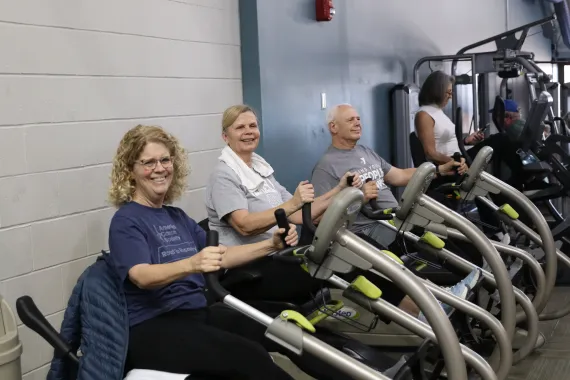
Especially when you don't want to. You do not need a perfect workout. You do not need to hit a personal record, follow a program, or show up looking put together. You need twenty minutes and a willingness to try. Walk on the treadmill. Sit in the sauna. Take the group fitness class you've been eyeing for three months. The barrier to entry is lower than your depression is telling you it is, and the return on investment is higher than you might expect.
Protect your sleep like it's sacred.
Because it is. Sleep is the foundation for everything else — mood, resilience, decision-making, and emotional regulation. When we are sleep deprived, everything feels harder and darker than it actually is. If you are struggling mentally and you are also not sleeping, that is not a coincidence.
Drink water. Eat food that fuels you.
This sounds almost insultingly simple, but when mental health suffers, basic self-care is often the first thing to go. Skipping meals, running on caffeine, neglecting hydration are not neutral choices for a struggling nervous system.
Let yourself rest without guilt.
Rest is not laziness. Rest is recovery. A culture that glorifies being busy and exhausted has convinced too many people that slowing down is failure. It is not. It is wisdom.
Talk to someone.
A friend, a therapist, a counselor, a pastor, a doctor — someone. You do not have to have it all figured out before you reach out. You do not have to be in crisis to deserve support. You just have to be willing to say I'm not okay to one person who can help you carry it.
For the People You Love:
Check in — and mean it.
Not the passing "how are you" in the hallway that expects "fine" in return. The deliberate, sit-down, look-someone-in-the-eyes kind of check-in. "Hey, I've been thinking about you. How are you really doing?" Those four extra words — how are you really — can open a door that nothing else will.
Learn to sit in discomfort.
When someone shares something painful with you, the instinct is to fix it, minimize it, or shift the focus to the positive. Resist that urge. Sometimes, the most healing thing another person can do is simply stay. You don't need the right words. You need presence. "I don't know what to say, but I'm not going anywhere" is one of the most powerful sentences in the English language.
Trust your gut.
If something feels off about someone you love — if there's a change you can't quite name, a distance that wasn't there before, a calm that doesn't match the storm you know they've been in — trust that feeling. Don't talk yourself out of it because you don't want to be wrong or make it awkward. Awkward is survivable. Loss is not.
Ask the hard question directly.
If you are genuinely worried that someone may be thinking about ending their life, ask them. Say the words out loud. "Are you thinking about suicide?" It will feel impossible to say. Say it anyway. It tells the person in front of you that you are not afraid of their darkest place and that you will not abandon them there. That message alone can be enough to keep someone here one more day.
Show up after the crisis.
One of the loneliest experiences a person can have is the silence that follows a mental health crisis or a loss. The calls and casseroles come in the first week, and then the world moves on — but grief and recovery do not run on the world's schedule. Be the person who checks in at the three-month mark. Who sends a text on what would have been a birthday? Keep showing up.
You don't have to be a therapist or a crisis counselor to make a difference in someone's life. You just have to be paying attention. You just have to be willing to be a little uncomfortable in the service of someone you love.
My dad was surrounded by people who loved him. I have to believe that. But somewhere in the gap between the love that existed and the help that reached him, he slipped away. I don't want that to happen to anyone else's dad. Or mom. Or child. Or friend.
You have more power than you know. Please use it.
Part Six: Resources — Because Knowing Where to Turn Matters
If anything in this blog has stirred something in you — whether that's concern for yourself, worry about someone you love, or simply the recognition that you've been carrying something heavier than you've let on — please don't stop here.
Awareness is the first step. Action is what saves lives.
Below are real, accessible resources staffed by people who are trained to help and who genuinely want to. You do not have to be in immediate danger to reach out. You do not have to have the perfect words. You just have to make contact.
If you or someone you know is in crisis:
988 Suicide & Crisis Lifeline
Call or text 988 — available 24 hours a day, 7 days a week. Free, confidential support for people in distress and those who love them. You can also chat online at 988lifeline.org
Crisis Text Line
Text HOME to 741741. Free, 24/7 crisis support via text message — for moments when calling feels like too much.
If you're looking for support, education, or connection:
NAMI — National Alliance on Mental Illness
nami.org | Helpline: 1-800-950-6264. Education, support groups, and advocacy for individuals and families navigating mental health conditions.
American Foundation for Suicide Prevention
afsp.org. Resources for suicide loss survivors, prevention education, and community healing programs — including survivor support groups for people who have lost someone to suicide.
Mental Health America
mhanational.org. Free mental health screening tools, resources by condition, and help finding local support.
If you've lost someone to suicide:
Grief after suicide loss is its own kind of complicated, and you deserve support that understands that. The American Foundation for Suicide Prevention offers specific resources for survivors of loss at afsp.org, including local support groups where you can sit in a room with people who truly understand what you are carrying.
You are not alone in this.
At your local YMCA:
The Y is more than a gym. Our staff is here, we are paying attention, and we genuinely care about your whole health — not just your physical fitness. If you are struggling and don't know where to start, come in and talk to us. We can help connect you with community resources, wellness programming, and a community that will show up for you.
You belong here. No asterisks. No conditions.
Reaching out is not a weakness. It is the bravest, most important thing you can do — for yourself, and for every person in your life who needs you in it.
Part Seven: What I Want His Story To Do
My dad has been gone since 2011.
That's over a decade of birthdays without his laugh at the table. Over a decade of moments, I've wanted to pick up the phone and call him. Over a decade of piano keys that don't get played the way only he could. Grief doesn't follow a timeline, and anyone who has loved and lost someone knows that it doesn't ever go away — it just slowly, imperfectly, learns to share space with the rest of your life.
I have made peace with the fact that I will carry this forever. What I have not made peace with — what I refuse to make peace with — is the idea that his story has to end at his death.
He was too generous for that. Too brilliant. Too funny. Too gifted. The man who let families walk out of his store with groceries they couldn't pay for deserves to keep giving, even now. And if the story of his life and his death reaches one person who recognizes a sign they might have otherwise missed — if it prompts one phone call, one honest conversation, one moment where someone chooses to ask the hard question instead of looking away — then he is still here, still giving, still making the world a little warmer.
That is what I want his story to do.
I want it to soften the heart of the reader, who has been keeping everyone at arm's length because they don't want to be a burden. You are not a burden. You are someone worth fighting for, and there are people in your life who would rather be uncomfortable in a hard conversation than stand at the graveside wishing they had said something.
I want it to reach the person who has been watching someone they love change in ways they can't quite name — who has that quiet, persistent unease that something is wrong but hasn't trusted it enough to act. Trust it. Act on it. Be wrong and be grateful you were wrong. Please.
I want it to find the person who lost someone and has been sitting alone in that grief, surrounded by silence and whispers, wondering why no one seems to know what to say. I know what that feels like. You are not forgotten, and you are not alone, even when it feels exactly like that.
And I want it to reach the person in the tunnel right now. Who is so exhausted by the weight of it that the idea of a way out feels like relief instead of loss. Please hear me when I say: the light you are looking for is not at the end of that tunnel. It is here, on this side, in the people who love you and in the version of yourself that exists beyond this pain. That version is real. That life is still possible. And there are people, trained, willing, genuinely caring people — available to you right now, today, at any hour, who want to help you find your way back to it.
Call 988. Text HOME to 741741.
Walk into your local Y.
Tell one person the truth about how you're doing.
Just stay.
My dad couldn't. But you can. And the world — your world, the specific and irreplaceable world that exists because you are in it — needs you to.
In memory of my dad. The man who gave everything he had to everyone around him, and deserved so much more in return.
May his story be what helps someone else stay.
-Jesa K., Health & Wellness Director - Westview YMCA